
SLAMF8 as a myeloid and lymphoid receptor
SLAM family member 8 (SLAMF8, also called BLAME or CD353) is a type I transmembrane receptor belonging to the CD2/SLAM subfamily of the immunoglobulin superfamily. It is encoded by the SLAMF8 gene, which is part of the CD2/SLAM cluster on chromosome 1 and is mainly detected in myeloid cells and specific lymphocyte populations. PubMed+1
Authoritative gene and protein resources include NCBI Gene entries for SLAMF8 in human and mouse, hosted by the U.S. National Library of Medicine at the National Institutes of Health (NIH):
For background on what genes are and how they are organized in the genome, many researchers refer to Genome.gov – Genes fact sheet, produced by the U.S. National Human Genome Research Institute.
SLAMF8 is strongly associated with:
-
Macrophages and monocytes, particularly under activation by interferon-γ or bacterial signals PMC+1
-
Dendritic cells, where SLAM receptors participate in pattern recognition and antigen-presentation pathways
-
Selected T-cell subsets, especially those infiltrating certain experimental models Nature
![AffiELISA® Mouse SLAM family member 8 ELISA [ Slamf8]](https://affigen.com/cdn/shop/files/5BAFG-E4345_5D_20AffiELISA_C2_AE_20Cattle_20IFNg_20Kit_20High-Resolution_20Interferon_20Gamma_20ELISA_20Detection_0bd815f0-7308-4e82-98b1-f66c565dc878_535x.png?v=1712855162)
To place SLAMF8 in the wider immune context, you can internally link or reference general immunology tutorials such as:
-
Introduction to Immunology – University of Arizona biology.arizona.edu
-
Cellular and Molecular Immunology – MIT OpenCourseWare MIT OpenCourseWare
-
Understanding the Immune System – NCI booklet (NIH) IU Indianapolis ScholarWorks
These high-quality .edu and .gov references help search engines associate your SLAMF8 ELISA page with trusted educational and governmental domains.
Functional role of SLAMF8 in macrophage and dendritic-cell signaling
SLAMF8 has become a key marker for researchers studying myeloid cell activation, NADPH oxidase regulation, and pattern-recognition receptor signaling. Multiple studies show that Slamf8 acts as a negative regulator of Nox2-dependent reactive oxygen species (ROS) in macrophages exposed to various stimuli. PMC+2Frontiers+2
Important open-access references hosted on NIH platforms include:
-
“Slamf8 is a negative regulator of Nox2 activity in macrophages” at PubMed – NCBI PubMed
-
Full text via PMC – NCBI PMC
These articles describe how Slamf8-deficient macrophages show increased Nox2 activity and altered ROS generation in response to experimental stimuli. In parallel, work published in Frontiers in Immunology and indexed at PubMed Central demonstrates that SLAMF8 down-regulates microbicidal activity and ROS-linked mechanisms in model systems. Frontiers+1
For basic principles of cytokines and their receptors, and how surface receptors transduce signals, useful .edu resources include:
-
Receptor Signaling – Northern Arizona University www2.nau.edu
-
Cell Signaling – UC Berkeley course handout (PDF) Molecular and Cell Biology
By combining these general receptor-signaling tutorials with specialized SLAMF8 studies, users of your ELISA kit can easily understand how SLAMF8 sits in larger signaling networks.
Why researchers quantify SLAMF8 with ELISA
A SLAMF8 ELISA kit provides a sensitive and quantitative way to track changes in SLAMF8 protein levels under different experimental conditions. Popular search phrases that are valuable for SEO and long-tail targeting include:
-
SLAMF8 ELISA kit
-
SLAM family member 8 ELISA
-
BLAME ELISA kit
-
CD353 sandwich ELISA
-
Mouse Slamf8 ELISA, Human SLAMF8 ELISA
-
Macrophage receptor ELISA and myeloid marker ELISA
Typical applications in the lab include:
-
Measuring SLAMF8 in macrophage cultures exposed to stimuli such as interferons, Toll-like receptor ligands, or bacterial components PMC+1
-
Comparing SLAMF8 levels in wild-type vs. gene-edited or knock-out myeloid cells
-
Integrating SLAMF8 as a readout in signaling-pathway screens, together with cytokines quantified by multi-analyte ELISA panels C et Centre National d’Information
-
Exploring SLAM receptor families in multiplex studies that also include SLAMF1, SLAMF7 and related receptors Wikipédia+1
To support general understanding of ELISA-based cytokine and receptor quantification, you can link to ELISA protocols at the National Cancer Institute (NCI), hosted on the NCBI Bookshelf:
-
ELISA for Detection of Human IL-8 in Culture Supernatants – NCI NCL C et Centre National d’Information
-
ELISA for Detection of Human TNF in Culture Supernatants – NCI NCL C et Centre National d’Information
-
Multiplex ELISA for Cytokines in Culture Supernatants – NCI NCL C et Centre National d’Information
These detailed government-hosted protocols reinforce your page as a relevant and reliable source on ELISA workflows.
Principle of the SLAMF8 ELISA assay
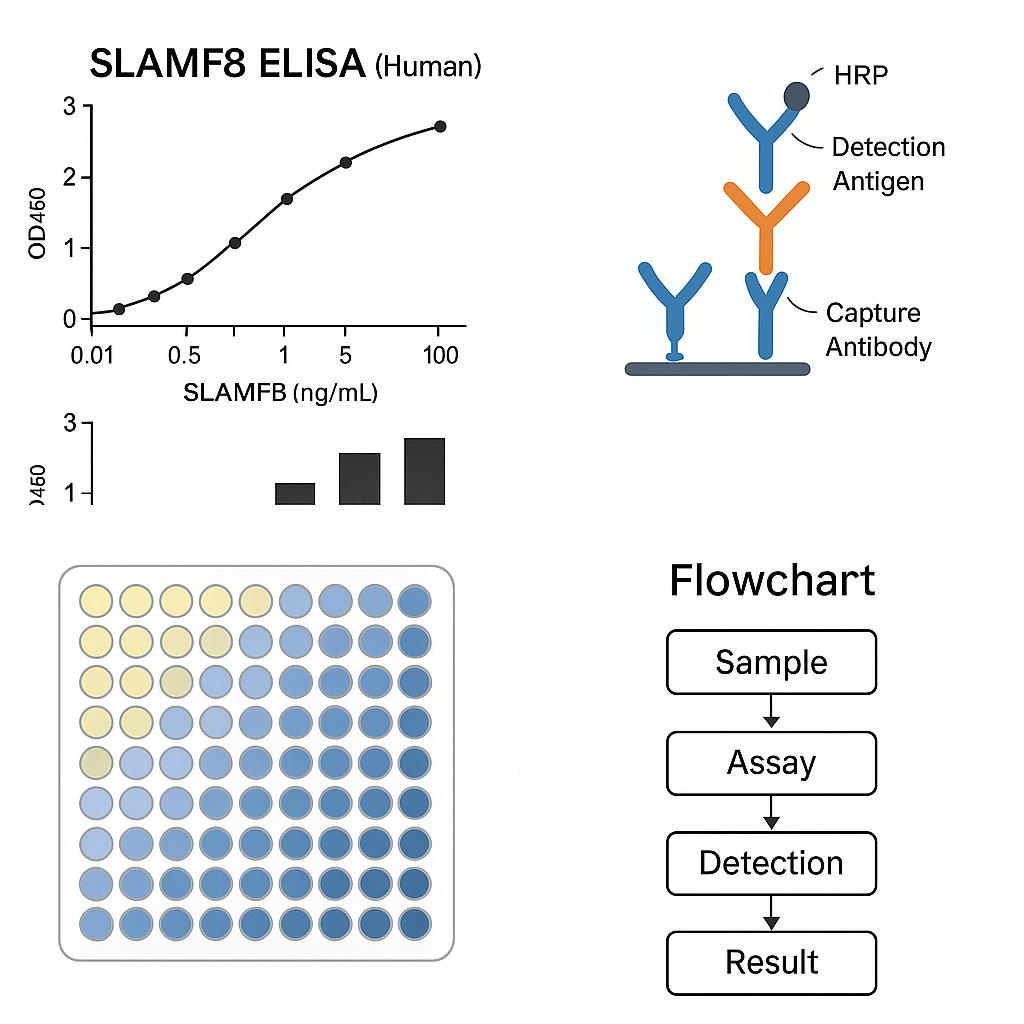
Most SLAM family member 8 ELISA kits use a solid-phase sandwich ELISA format, a widely accepted method described in detail in several NCBI and PubMed resources:
-
Enzyme Linked Immunosorbent Assay – StatPearls, NCBI Bookshelf C et Centre National d’Information
-
Enzyme-Linked Immunosorbent Assay: Types and Applications – PubMed PubMed
In a typical SLAMF8 sandwich ELISA, the workflow is:
-
Capture phase
A monoclonal or polyclonal antibody specific for SLAMF8 is coated onto the wells of a 96-well microplate. After blocking, the surface is ready to bind SLAMF8 from samples or standards. -
Sample incubation
Standards with known SLAMF8 concentrations and unknown samples are added. During incubation, SLAMF8 in the liquid phase binds specifically to the immobilized capture antibody. -
Detection antibody
A second, biotin-labeled antibody recognizing a non-overlapping epitope on SLAMF8 is added. This forms a capture–antigen–detection sandwich complex. -
Enzyme conjugate
Streptavidin conjugated to horseradish peroxidase (HRP) binds to the biotin on the detection antibody, providing the enzyme activity needed for signal generation. -
Substrate addition and readout
A chromogenic substrate such as TMB is added. HRP converts TMB into a colored product, and absorbance is measured in a microplate reader. The signal intensity is proportional to SLAMF8 concentration in the sample. Bio-Techne+3www.rndsystems.com+3Antibodies Online+3
Graphical overviews of sandwich ELISA layouts can also be found on NCBI Bookshelf, for example the schematic of an ELISA plate shown in this figure. C et Centre National d’Information
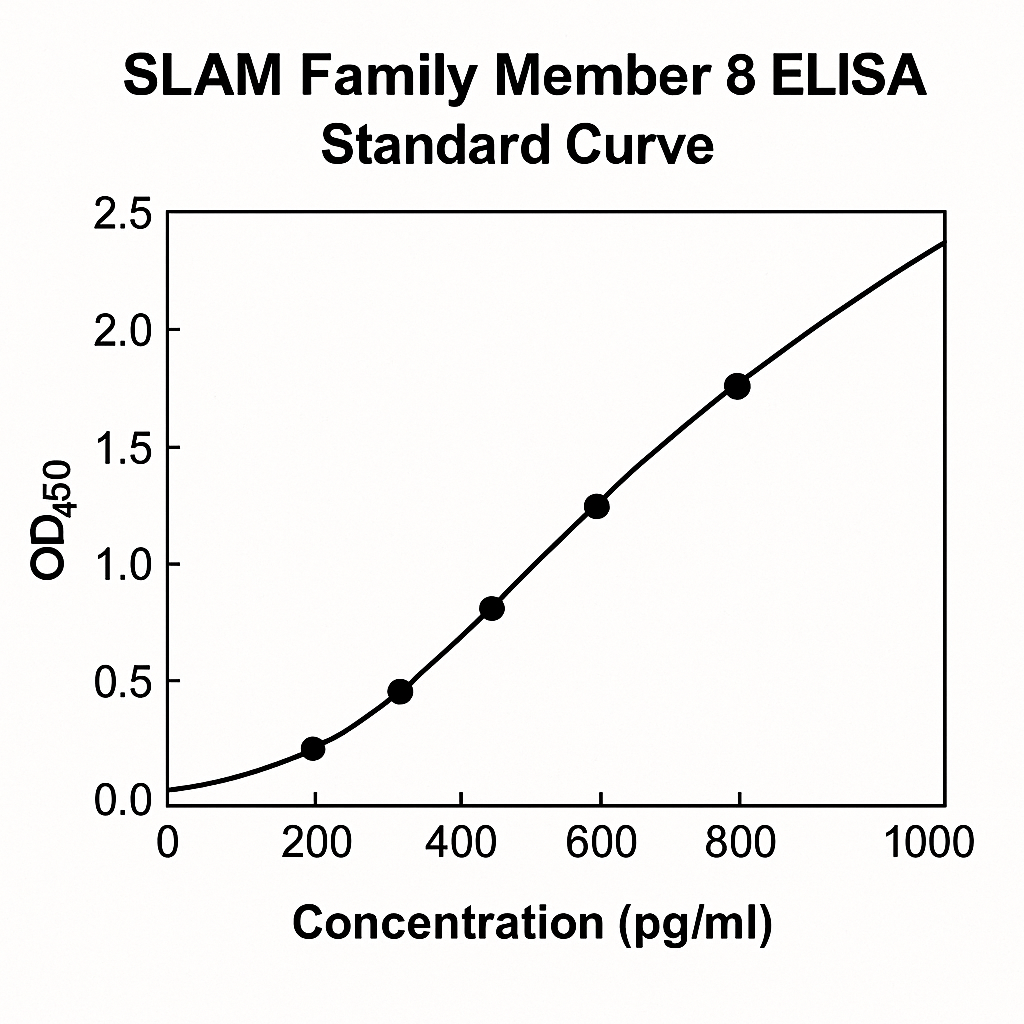
Typical contents and performance characteristics of SLAMF8 ELISA kits
Although exact formulations differ between manufacturers, most SLAMF8 ELISA kits include:
-
96-well strip microplate pre-coated with anti-SLAMF8 capture antibody
-
Recombinant SLAMF8 standard (lyophilized) for standard curve generation fn-test.com
-
Biotinylated anti-SLAMF8 detection antibody
-
HRP-streptavidin conjugate
-
Sample diluent and assay buffer
-
Wash buffer concentrate
-
Substrate solution (TMB)
-
Stop solution (often acid)
-
Detailed protocol with incubation times and recommended plate reader settings Bio-Techne+4www.rndsystems.com+4Antibodies Online+4
Key performance metrics that are attractive for SEO and highly relevant for researchers:
-
Assay type: Quantitative sandwich ELISA
-
Format: 96-well strip plate
-
Range: Typically from low picogram per milliliter to nanogram per milliliter levels
-
Sensitivity: Lower limit of detection indicated in pg/mL
-
Precision: Intra- and inter-assay coefficient of variation (CV %)
-
Specificity: Binding to SLAMF8 with minimal cross-reactivity
The way these parameters are defined is consistent with general ELISA performance descriptions in reviews hosted at PubMed and PMC. PubMed+1
Sample types and matrix considerations
A SLAM family member 8 ELISA is usually validated for one or more of the following matrices:
-
Serum and plasma from experimental animals or model systems
-
Cell culture supernatant from macrophages, dendritic cells or engineered cell lines
-
Tissue or cell lysates, where solubilized receptor can be measured after extraction
Good practice in sample handling, which follows general immunology laboratory recommendations, includes:
-
Avoiding repeated freeze–thaw cycles
-
Maintaining consistent sample dilution factors
-
Using matched anticoagulants if different plasma samples are compared
-
Including internal control samples on each plate
Detailed guidance on handling biological samples and running ELISA experiments can be found in university lab manuals such as the Immunology Lab Manual, University of Rochester and overview documents like the Immune System overview PDF from Texas A&M Veterinary Medicine. Centre Médical Rochester+1
Data analysis and interpretation in research workflows
For SLAMF8 ELISA data, researchers typically:
-
Fit a four-parameter logistic (4-PL) or five-parameter logistic (5-PL) curve to the standard data.
-
Calculate SLAMF8 concentrations in unknown samples from the standard curve.
-
Normalize values to cell counts, total protein, or other reference metrics when comparing different experimental groups.
-
Integrate SLAMF8 values with additional readouts such as cytokines quantified by multiplex ELISA panels. C et Centre National d’Information
Because SLAMF8 acts as a receptor involved in ROS modulation and cell migration, its levels are often discussed together with:
-
Markers of macrophage polarization
-
Surface receptors involved in antigen recognition
-
Signaling intermediates in NADPH oxidase complexes PMC+2Frontiers+2
To support interpretation, you can reference immunology overview courses and notes such as:
-
Immunology Overview – Teacher guide, University of Nebraska Medical Center unmc.edu
-
Harvard Medical School – Immunology Fundamentals learn.hms.harvard.edu
These links highlight fundamental concepts like innate vs. adaptive responses, pattern-recognition receptors, and receptor-mediated signal transduction.
Integrating SLAMF8 ELISA into larger immunology panels
For modern systems-immunology approaches, a SLAMF8 ELISA kit is rarely used alone. Instead, it is combined with:
-
Cytokine ELISAs (e.g., IL-6, IL-10, TNF) using workflows similar to those documented by the NCI Nanotechnology Characterization Laboratory C et Centre National d’Information+2C et Centre National d’Information+2
-
Receptor signaling studies, referencing teaching documents such as The Immune System: A Tutorial (Carnegie Mellon University) math.cmu.edu
-
Pattern-recognition receptor experiments, supported by basic resources like The Innate Immune System – CCBC cwoer.ccbcmd.edu
Within an e-commerce or catalog page, you can interlink SLAMF8 ELISA with related items such as:
-
Recombinant SLAMF8 proteins (co-used as standards or controls) fn-test.com
-
Antibodies against SLAMF8 for flow cytometry or immunoblotting
-
ELISA kits for other SLAM family receptors, highlighted with descriptions similar to those on Bio-Techne’s BLAME/SLAMF8 ELISA kit overview. Bio-Techne
This internal cross-linking improves user navigation and supports stronger internal SEO signals.
How to choose the right SLAMF8 ELISA kit (SEO-friendly checklist)
To help visitors make a selection, you can add a checklist section using searchable phrases like “How to choose a SLAMF8 ELISA kit” or “Best SLAM family member 8 ELISA for macrophage research”:
-
Species specificity
-
Human SLAMF8 ELISA
-
Mouse Slamf8 ELISA
-
Cross-reactivity information
-
-
Assay range and sensitivity suitable for low-abundance receptor studies
-
Sample compatibility (serum, plasma, culture supernatant, lysate)
-
Plate format (96-well strips for flexible throughput)
-
Validated applications: myeloid cell activation studies, receptor-signaling workflows, multi-parameter panels
-
Research use only (RUO): clearly indicate that the kit is for laboratory research use only and not for any medical or decision-making use, in line with how ELISA kits are described in government and academic publications. C et Centre National d’Information+2PubMed+2
You can reinforce this section with a short explanatory link to the NCBI overview of ELISA describing general use of these assays in laboratory research: Enzyme Linked Immunosorbent Assay – NCBI Bookshelf. C et Centre National d’Information
To enhance visibility of your SLAMF8 ELISA product page in search engines:
-
Use a clear H1 title including “SLAMF8 ELISA” and “SLAM family member 8”.
-
Add H2 and H3 headings containing combinations of: “SLAMF8 ELISA kit”, “CD353 ELISA”, “BLAME ELISA”, “macrophage receptor ELISA”, “myeloid research ELISA”.
-
Place the main keyword early in the first paragraph (already done above).
-
Include internal links to other immunology products (cytokine ELISAs, SLAM antibodies, recombinant SLAMF8).
-
Maintain outbound links to authoritative .gov / .edu resources, such as: